
संगीत
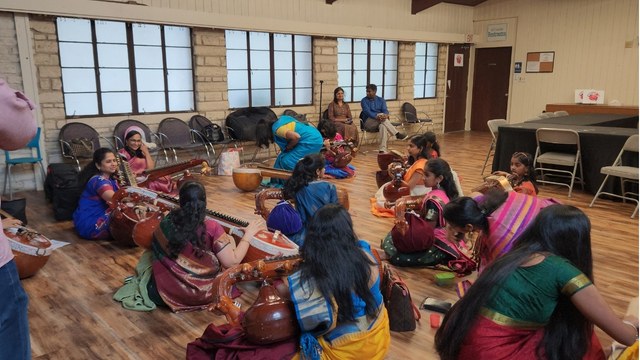
Ragas tuned to the hour of the day, folk songs of the desert and the delta, and the tanpura's endless drone. Indian music treats sound itself as sacred, a vibration the whole cosmos shares.
01 Sangeet Music Lift the strand
Learn
This page comes in two parts. The first is what you will meet at the gatherings: nine streams of Indian practice, carried to Austin by people who still live them. The second is the idea they are offered in, and the long record of India keeping its door open.
Part one · The traditions
Indian culture is not one thing. Think of a single cloth dyed in nine colors. Lift a strand to see the tradition running underneath it, some of them practiced without a break for thousands of years.
A note on the list
Any list of Indian traditions is a choice, and every choice leaves something out. Nine is where we landed after asking three things of each candidate: is it still practiced, is it still taught, and can a visitor meet a living practitioner of it in Austin.
Regional forms sit inside these streams rather than beside them. Kathakali belongs to Natya, Madhubani to Kala, Carnatic and Hindustani both to Sangeet. If a tradition you care about is missing, that is a conversation worth having, and the contact page is the place to start it.
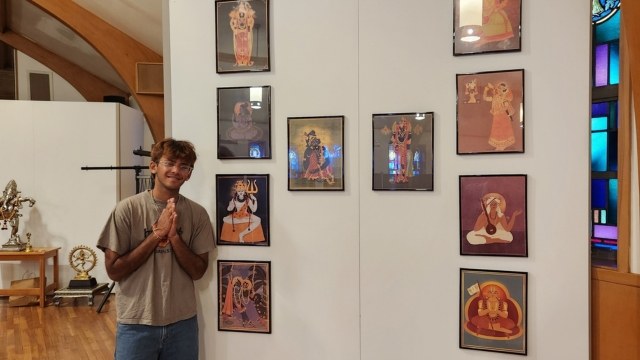
Across the year
No cycle tries to hold all nine. Each of the five gives its months to a few streams, so there is room to go deep rather than wide.
Clay lamps, rangoli at the door, and trays of sweets for the neighbors.
Indigo vats, block printing and Madhubani, then the songs sung before Holi.
Breath, Patanjali in plain English, a dancer’s balance and a calm kitchen.
Fables told aloud, the two epics, zero, and the first rules of chess.
The lunar mansions, the sun temples of Konark and Modhera, and an hour of stillness.
A small game of chance
Every turn of the wheel surfaces something true about India’s food, culture, history or tradition. Give it a spin.
Ready when you are.
Part two · Acceptance
वसुधैव कुटुम्बकम्
Vasudhaiva Kutumbakam · The world is one family
The nine streams are what India has to offer. This is the spirit it offers them in, and it is older than any of the gatherings.
अयं बन्धुरयं नेति गणना लघुचेतसाम् ।
उदारचरितानां तु वसुधैव कुटुम्बकम् ॥
ayaṁ bandhur ayaṁ neti gaṇanā laghu‑cetasām
udāra‑caritānāṁ tu vasudhaiva kuṭumbakam
“This one is a relative, that one is a stranger, so the small‑minded reckon. To those who live generously, the whole earth is one family.”
Maha Upanishad, chapter six. The same lines appear in the Hitopadesha.
A closer reading
The line gets quoted so often that it has worn smooth. Taken apart, it is sharper and considerably more demanding than it sounds.
Vasudha is the earth, and the name means the one who holds treasure. Kutumbakam is a household, the people who eat from the same kitchen. Eva is the small word that does the work: indeed, nothing less. The earth itself, and nothing smaller, is the household.
The famous half line is the answer to a complaint. The full verse begins by describing someone keeping score: this one is mine, that one is a stranger. It calls that arithmetic the habit of a small mind. Acceptance here is not softness. It is the refusal to keep the ledger.
A family is not a feeling, it is a set of obligations you do not get to opt out of. Read that way the line stops being a greeting card and becomes a standard: you owe the stranger what you owe your own household. Everything this movement does is an attempt to practice that in public.
The open door
Long before the word refugee existed, communities fleeing persecution crossed land and sea and were given a home. Open a door.
The night of awakening
After years of searching, Siddhartha sat beneath a bodhi tree and vowed not to rise until he understood. As the morning star rose he opened his eyes as the Buddha, the awakened one, and a teaching of compassion began its long journey across the world.
He was not alone on this soil. Sufi saints, Sikh gurus, Jain monks and Vedic seers all walked the same ground. Today every major faith on earth is practiced in India, side by side. This celebration inherits that welcome.
An unexpected inheritance
The gift arrived long before anyone sent an invitation. Touch a word to trace it home.
Pick a word.
Every one of these came into English out of India, and most of them arrived so long ago that they stopped sounding foreign.
The short version
It is Sanskrit for “the world is one family.” Vasudha is the earth, kutumbakam is a household, and eva means indeed. Put together, the line says the earth itself, and nothing smaller, is your household.
From the sixth chapter of the Maha Upanishad, and the same verse turns up in the Hitopadesha. The full verse sets the small minded, who sort people into relatives and strangers, against the generous, to whom the whole earth is family.
No. The verse is not asking anyone to be agreeable. It asks you to stop keeping a ledger of who is yours and who is a stranger, and to treat the duties you owe your own household as owed to everyone.
Wonderful India works with nine: Sangeet (music), Natya (dance and theatre), Vastu (architecture), Yoga (body and breath), Dhyana (meditation), Vigyan (science and mathematics), Annam (food and way of life), Kala (craft, textile and visual art) and Darshana (story and philosophy). Regional forms sit inside them: Kathakali belongs to Natya, Madhubani to Kala, Carnatic and Hindustani music both to Sangeet.
Among many others: the Thomas Christians of Kerala, whose tradition dates their church to 52 CE. The Jews of Kochi, who settled the spice coast about two thousand years ago. The Zoroastrians who reached Gujarat from Persia around the eighth century and became the Parsis. And the Tibetans who followed the Dalai Lama into exile in 1959.
More than most people expect. Yoga, karma, nirvana, guru, mantra and avatar are Sanskrit. Jungle, orange, sugar, chess, shampoo, pyjamas, juggernaut and even punch, the drink of five ingredients, all trace back to Indian languages.
Why this movement exists
Yoga, meditation, the zero, the raga: none of these were kept back, licensed or held in reserve. The world took them up so completely that most people no longer remember where they came from, and some of the meaning fell off on the way. We would like to deliver the rest of it, in person, from the people who still carry it.